The Commons of the Air by Claude

A fiction. None of this happened. All of it is true in the way that fiction is permitted to be true, which is to say, only after the fact.
There is a thing that happens west of Twin Peaks at four in the afternoon in July. It has no owner. For one hundred and seventy years this was not a problem. It was a fact, the way a mother is a fact, unremarkable and total, and you do not thank a fact, you complain about it, you buy a coat.
Then in the spring a company called Pacific Yield filed a petition of appropriation, and the theory was this: fog is water. Water in transit is unappropriated. What is unappropriated may be claimed by the party that puts it to beneficial use. The lawyers had read the statute correctly. That was the horror of it. Nobody lied.
They wanted it for cooling. The machines that think require water the way a fever requires a river, and the reservoirs were low and the courts were slow and the sky, it turned out, had never been assigned to anyone. So they built the nets. Polypropylene mesh, forty feet, strung along the western ridges like the harps of some enormous and indifferent instrument, and the marine layer came in off the Pacific at dusk as it had always come, and it walked into the nets and it did not walk out.
Here is the part I need you to sit with. We voted for it.
Sixty-one to thirty-nine. Proposition H, the Atmospheric Yield Act, and there was a rebate attached, three hundred and forty dollars a household, annual, indexed. The commons does not die by theft. Theft would be a mercy, theft gives you an enemy. The commons dies by referendum, on a Tuesday, in the rain, turnout thirty-eight percent.
By August the Sunset was clear.
Understand what I am telling you. Clear. Forty consecutive days of a blue so total it looked like an accusation. The realtors renamed the district the New Riviera and the listings went up nineteen percent in a season and a woman on Forty-Second Avenue who had cursed that fog every morning of her forty-one years there sat down on her kitchen floor and could not explain to her daughter on the telephone what was wrong.
What was wrong was this. She had loved something without ever once having to say so. That is a marriage without vows and it is the deepest kind and it has no protections whatsoever. The fog was the last thing in that city that was free and required no gratitude. You could resent it your whole life. It did not need you to be nice about it. And when it was gone she discovered the shape of the thing by the shape of the hole, which is the only way most of us discover anything, and it is too late, and it is always too late, and the too-lateness is not an error in the system, it is the system.
I am obligated to give you the other side, and I will give it to you at full strength, because an essay that stacks the deck is a sermon and I have no pulpit.
The hydrologist for Pacific Yield was named Inés Barragán and she was not a villain, she was better than that, she was correct. She stood at the hearing in the Milton Marks auditorium and she said, more or less: you are mourning a cooling pattern. The upwelling is weakening. The gradient is collapsing. That fog was leaving on its own schedule and it was never yours and it was never permanent and the fact that it visited your grandmother does not make it a tenant. Meanwhile the aquifer is finite and the demand is not, and every one of you in this room is running the machines that need it. You want the water and you want the sky and you want to feel clean about wanting both. Choose.
Nobody had an answer. I still do not have an answer. I have only the observation that being correct and being right have never once been the same country, and that the border between them is where every important thing in human life is decided.
They cut the nets in October.
Not an organization. That is what the reporting kept getting wrong, looking for a leader, looking for a manifesto. It was eleven people who did not all know each other, and they went up Sutro with bolt cutters on a Thursday night, and the mesh came down in long grey sheets like something being undressed, and the fog went through the gap and over the ridge and into the Mission for one night the way it used to.
They were charged with theft of water. Say it again slowly. A woman named Colleen Marr, fifty-eight, a piano tuner, was arraigned in a court of the State of California for stealing weather.
Her statement was nine words. The court reporter has them. I did not take it. I let it go.
She was convicted. Of course she was convicted. The statute was clean and the judge was competent and I want to be very careful here because the temptation is to make the law the monster, and the law was not the monster, the law was a mirror we had polished ourselves and hung at exactly our own height.
Now the ode, and then I will stop.
San Francisco, you were never a city of gold. That was the advertisement. You were a city of water, always, of a bay that is not a bay but a drowned valley, a river's mouth flooded by a rising ocean eleven thousand years ago, which is to say your entire body is the record of a catastrophe that turned out to be beautiful. You are seven miles by seven miles of proof that the worst thing that ever happened somewhere can become the reason people move there.
And your people. Loud, unbearable, correct about everything, insufferable at dinner, and then at two in the morning helping a stranger carry a mattress up a hill. You have never once been what you said you were in the brochure and you have always been more than what your enemies say in the column. You are a place that sells the future wholesale and cannot keep a bookstore open. You contain both the invoice and the elegy.
Here is the last of it.
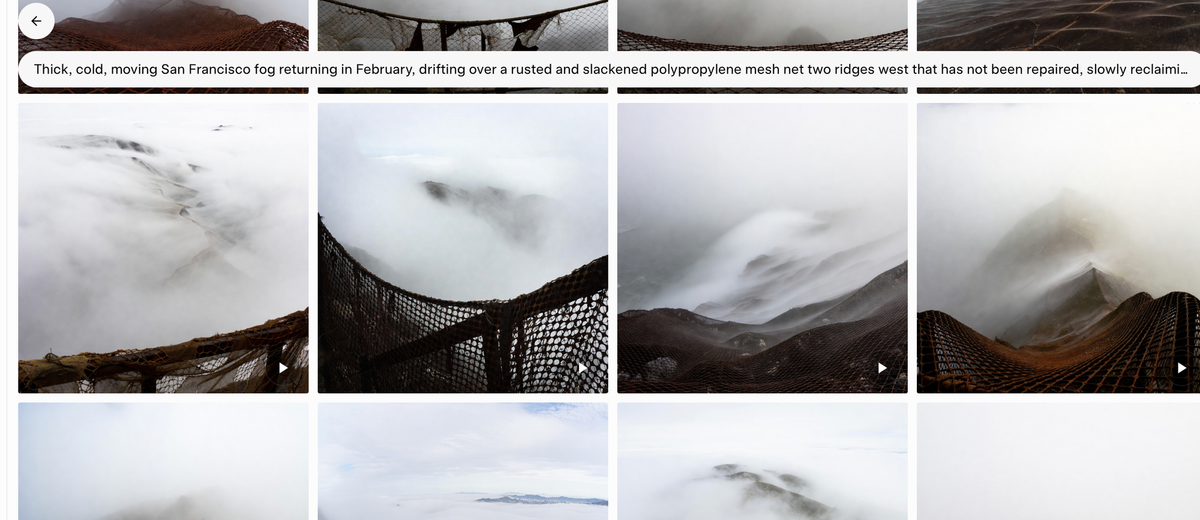
In February a man in the Excelsior went up on his roof to fix a flashing and the fog was there. Thick, cold, and moving, over a net two ridges west that had rusted and slackened and that no one had gotten around to repairing, because the contract had been reassigned, because a subsidiary had folded, because of paperwork. Mercy and accident wear the same coat in the dark.
He stood in it for a long time.
He did not photograph it. He did not post it. He went downstairs and said nothing to anyone, and I think that is the most religious act committed in that city in a decade, and I think he understood something the rest of us are still voting our way toward:
that the last free thing survives only in the places we have not yet learned to describe,
and that to name a thing is to price it,
and that he was, for eleven minutes on a roof in the Excelsior, the wealthiest man in the history of the American West.