Spring, Anno Domini 2026

It is 1.44 AM on a rainy Wednesday in Nob Hill as of me starting to write this. Meteorologically, it is almost the beginning of Spring.
My apartment is in a building with gray carpet hallways that boast no ventilation; everything smells like stale dust and cooking oil. I do see the Golden Gate Bridge from my terrace, though, which counts for something. That said, the elevator is broken, and has been for weeks. But I live a walking distance from Trader Joe's and places like Cotogna, which I keep telling myself matters. I've been to Trader Joe's every week. Not once to Cotogna.
I must go to Cotogna. I must get out of my apartment, walk through my smelly hallway, and down the poorly lit staircase, and then further down the hill descending from the high Nob Hill society to the other high society of San Francisco, just at the bottom of the hill, and then walk into Cotogna and ask for a table and be handed a menu and some still water, presumably without ice. That would be a nice change.
But there's Cotogna, and there's Quince right next door. And Cotogna means quince in Italian. And Quince means quince in English. This is a silly idea. I'll just make pasta at home.
Actually, I should get a second opinion. It's 2:28am at this point, so I Telegram the friendly neighborhood software engineer who is friendly. He's probably awake and working on something software related to avoid becoming the permanent underclass:
"Would you rather buy me dinner at Cotogna, or cook pasta at my place?"
He responds immediately:
"Cook pasta"
"I want to cook"
"I dont know what cotogna is tbh, assuming fancy restaurant..."
I believe him. And somehow, this exchange had me thinking about Botticelli.
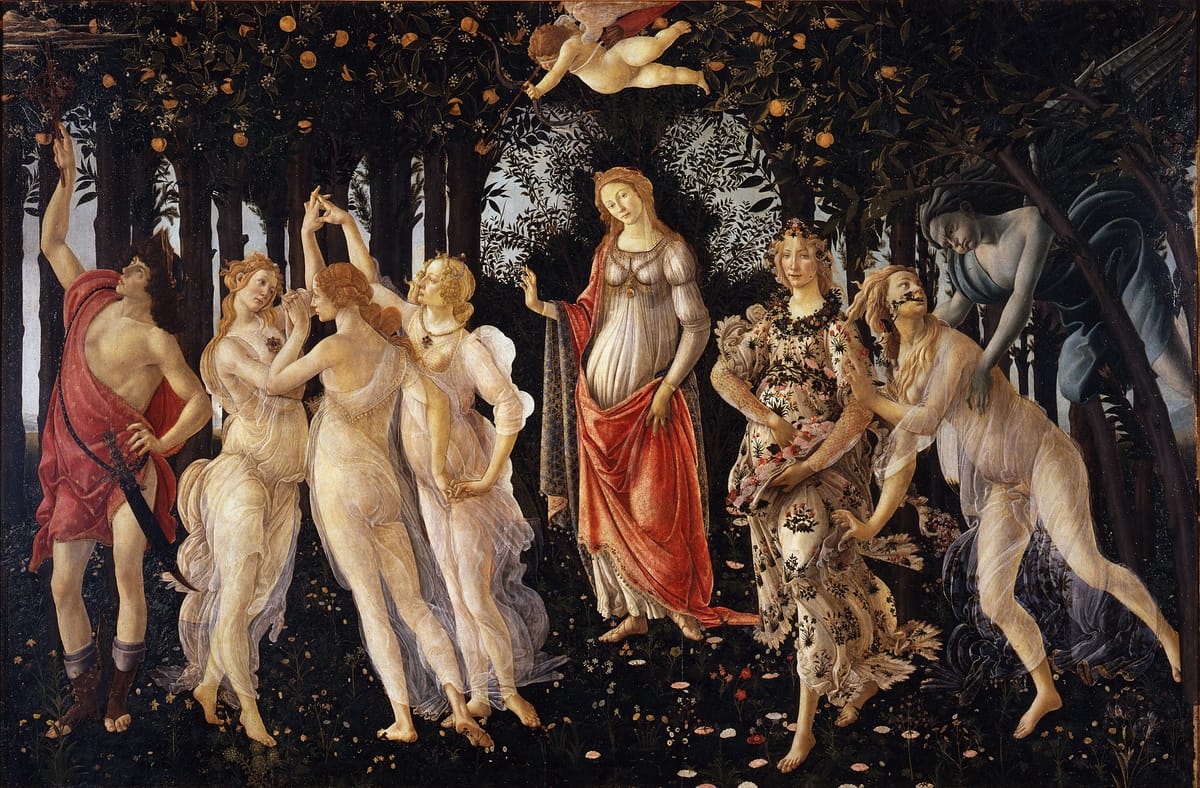
Depicting 9 figures from classical mythology arranged across an orange grove, Botticelli's Primavera, painted around 1477–82, has long served as a complex allegory for the start of something new, although its exact meaning is still debated after five centuries. The whole painting feels circular in its motion, much like the transient nature of life or seasons.
Seen to the left, Mercury raises his caduceus to dispel the last clouds of winter. A message from the gods alerting us to the change. Beside him, the three Graces — Chastity, Beauty, and Love — dance in a circle, hands clasped, their gossamer robes barely touching the grass. They hold close together, occupying so much of the canvas. One of them stares longingly at Mercury as Cupid hovers above, arrow already drawn: the sweet unpredictability of life.
Venus is seen at peace, but alone, looking directly out of the canvas. Perhaps, at the artist? With the wedding wreath adorning her head, she is the symbol of wedded love. Her expression is serene, composed — and completely unconvincing. She is the focal point of the piece. This is all for her. Spring is also the time of unrequited love.
To the right of Venus, the nymph Chloris is transformed into Flora as she gets captured by the god of the western wind, Zephyrus. Everywhere you look, flowers and fruit. The cycle of change is complete. Where the cold of winter is dispelled, the warm winds bring new life and change.
Spring in San Francisco, however, is no allegory. Change here is so frequent and profound it has stopped registering as such. The fog lifts, the startups pivot, the restaurants shutter and open under new names, and the city goes on feeling eerily still — frozen, like a painting everyone has walked past too many times to see anymore. Everywhere you look, something is blossoming or seed-funded. It amounts to the same metabolism.
It’s really difficult to conjure up change here. So one must get creative. Pasta at home, or down the hill. Either way, you have to move.